发布时间:2026-04-22
Recently, the paper titled "Reducing Patient Tardiness: From Experiment to Implementation," with Associate Professor Zhang Shichen from the Institute of Systems Engineering at Tianjin University's College of Management and Economics as the corresponding author and co-first author, was published online in Production & Operations Management, a top international journal in the field of operations management.
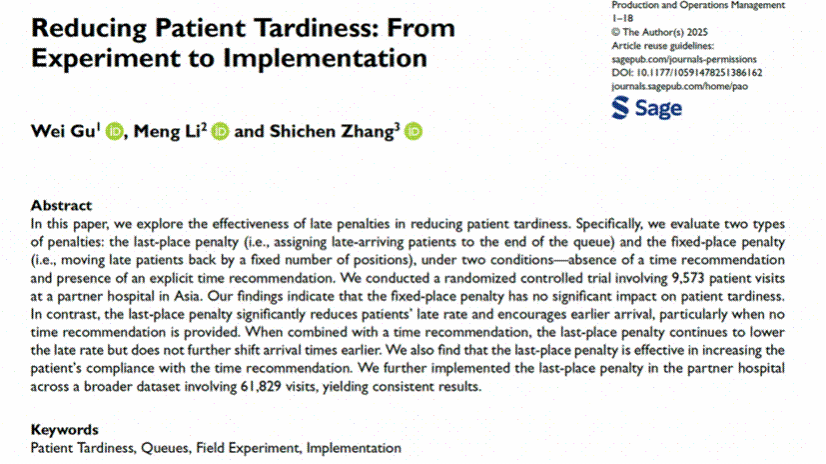
Paper Link: https://journals.sagepub.com/doi/abs/10.1177/10591478251386162
This research was completed in collaboration with Professor Gu Wei from the University of Science and Technology Beijing, Professor Meng Li from the University of Houston, USA, and Associate Professor Zhang Shichen from Tianjin University's College of Management and Economics. The study focuses on the pervasive phenomenon of patient tardiness in healthcare service settings. Methodologically, the research innovatively combines a large-scale randomized field experiment with full-scale implementation of field policies to validate the effectiveness of behavioral governance outcomes from incentive measures in real medical scenarios. It reveals the interaction between negative incentives (penalty measures) and behavioral nudges (time suggestions), providing generalizable strategies for hospitals to reduce patient tardiness and improve resource utilization. Based on the research findings, the relevant measures have been formally adopted and continuously implemented by the partner hospital.
Article Abstract
This paper investigates the effectiveness of tardiness penalties in reducing patient tardiness behavior. Specifically, we evaluate two penalty mechanisms: move-to-end (i.e., rescheduling tardy patients to the end of the queue) and move-by-fixed-slots (i.e., moving tardy patients back by a fixed number of slots), and test them in two contexts: without time suggestions and with a clear time suggestion. This study conducted a randomized controlled trial at a partner hospital in Asia, encompassing 9,573 patient visits. Our findings indicate that the move-by-fixed-slots penalty has no significant impact on patient tardiness. In contrast, the move-to-end penalty significantly reduces patient tardiness rates and leads patients to arrive earlier, especially when no time suggestion is provided. When combined with time suggestions, the move-to-end penalty still reduces tardiness rates but does not further promote earlier arrival. Furthermore, the study finds that the move-to-end penalty effectively improves patient compliance with time suggestions. The research then implemented the move-to-end penalty on a larger scale at the partner hospital (across 61,829 visits), and the results remained consistent with the above findings.
Production and Operations Management (POM) is a top-tier international business journal. Together with OR (Operations Research), MS (Management Science), and MSOM (Manufacturing & Service Operations Management), it is widely recognized as one of the four leading journals in the fields of management science and operations management. All four of these journals are included in both the UTD-24 list of top business school journals and the Financial Times 50 list.
Author Biographies

Zhang Shichen: Yingcai Associate Professor and Doctoral Supervisor at the Institute of Systems Engineering, College of Management and Economics, Tianjin University. She serves as Principal Investigator for one General Project and one Young Scientist Project of the National Natural Science Foundation of China. Her research focuses on using empirical methods such as field experiments to quantify how artificial intelligence creates and delivers value in management contexts. Her research findings have been published in international journals including Management Science, Manufacturing & Service Operations Management, Production and Operations Management, Decision Sciences, European Journal of Operational Research, and Omega.