发布时间:2026-04-13
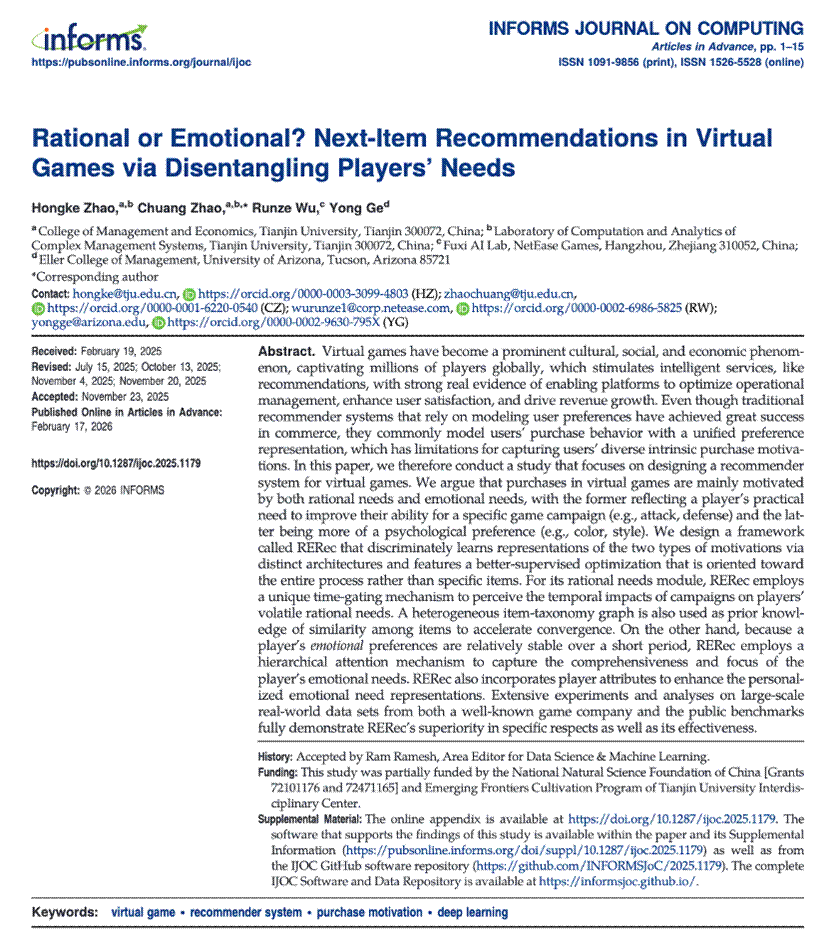
Recently, the paper titled "Rational or Emotional? Next-item Recommendations in Virtual Games via Disentangling Players' Needs," authored by Associate Professor Zhao Hongke from the Department of Information Management and Management Science at the College of Management and Economics as the first author, was published online in the INFORMS Journal on Computing, a top international journal in the field of information systems and computing.
Paper Link: https://pubsonline.informs.org/doi/10.1287/ijoc.2025.1179
This research was completed in collaboration between Associate Professor Zhao Hongke from Tianjin University's College of Management and Economics, Dr. Zhao Chuang, Researcher Wu Runze from NetEase Fuxi AI Lab, and Professor Yong Ge from the University of Arizona, USA. The study focuses on the cutting-edge issue of intelligent recommendation in virtual game scenarios. Methodologically, drawing on consumption motivation theory for the first time, the team deconstructed player purchasing behavior into two dimensions: rational needs and emotional needs. They innovatively designed a differentiated modeling framework called RERec, achieving a critical breakthrough from traditional unified preference modeling to fine-grained, motivation-aware recommendations, and systematically revealing the heterogeneous characteristics and dynamic evolution patterns of player needs in game scenarios. This achievement not only provides a new theoretical perspective and technical solution for recommendation systems in virtual games but also marks significant academic progress at the intersection of digital entertainment and artificial intelligence.
Article Abstract
Virtual games have become a global cultural and economic phenomenon. However, the challenge of accurately matching a vast selection of game items with player needs leads to decreased player engagement and reduced platform revenue. Traditional recommendation systems often adopt a unified preference modeling approach, making it difficult to capture the diversity of player purchase motivations in game scenarios: rational needs (such as improving offensive or defensive capabilities to address specific level challenges) are highly time-sensitive and periodic, while emotional needs (such as a preference for items of specific colors or styles) are relatively stable. Based on this, this paper constructs a dual-motivation disentangled recommendation framework called RERec. Orthogonal projection is used to decompose purchase sequences into rational and emotional need sequences. For rational needs, a time-aware gating network and an heterogeneous item classification graph are designed to accurately capture their dynamic characteristics. For emotional needs, a player-attribute-guided hierarchical attention mechanism is employed to deeply mine stable preferences. A process-oriented optimization mechanism is innovatively introduced, fully utilizing intra-sequence supervision signals to enhance model performance. Experiments demonstrate that this system achieves a 50% increase in player login frequency, a 50% increase in interaction rate, a 40% increase in sales conversion rate, while reducing churn rate by 16%, significantly outperforming mainstream recommendation algorithms on both real-world NetEase game datasets and public benchmark datasets.
The INFORMS Journal on Computing is a top international journal at the intersection of information systems and management science. Published by the Institute for Operations Research and the Management Sciences (INFORMS) in the United States, it is included in the prestigious UTD-24 list of top business school journals and holds an exceptionally high reputation in international academia. The journal focuses on innovative applications of computational methods and information systems in management, requiring published results to possess both theoretical depth and practical value. It is widely recognized as a premier academic exchange platform by scholars in relevant fields globally.
Author Biographies

Zhao Hongke: Yingcai Associate Professor, Specially Appointed Researcher, and Doctoral Supervisor at the College of Management and Economics, Tianjin University. He has published over 100 papers in top-tier journals and conferences including JOC, TKDE, TPAMI, TEVC, TOIS, Tourism Management, SIGKDD, and ICML. He was selected for the 2022 Baidu Scholar Global AI Young Chinese Scientist List (AI+X Intelligent Management). He has received the China Think Tank Index (CTTI) Annual Excellent Achievement Award (2019), the China Association for Artificial Intelligence (CAAI 2019) Excellent Doctoral Dissertation Nomination Award, the Runner-up Prize at ICML 2024 Challenges on Automated Math Reasoning, and the Third Prize at KDD-CUP 2019. His papers have been recognized as one of the "Top 10 Highly Cited Papers" in Journal of Computer Research and Development (2019), the Best Full Research Paper Runner-up at WSDM 2026, one of the Best-ranked Papers at WSDM 2022, "ESI Highly Cited Papers," and the Best Student Paper Award at the China Conference on Machine Learning (CCML 2019). He serves as Principal Investigator for a General Project and a Young Scientist Project of the National Natural Science Foundation of China, a special cooperation project in the Beijing-Tianjin-Hebei Basic Research area, a major project of the Tianjin Municipal Education Commission's Social Science program, the Lenovo Scientist Program, and the CCF-Lenovo Blue Ocean Fund, as well as collaborations with several technology enterprises (such as Lenovo, Baidu, NetEase, among others) that yield significant social benefits.